
Sponsored by

SnackOnAI Engineering | Senior AI Systems Researcher | Technical Deep Dive | November 22, 2026
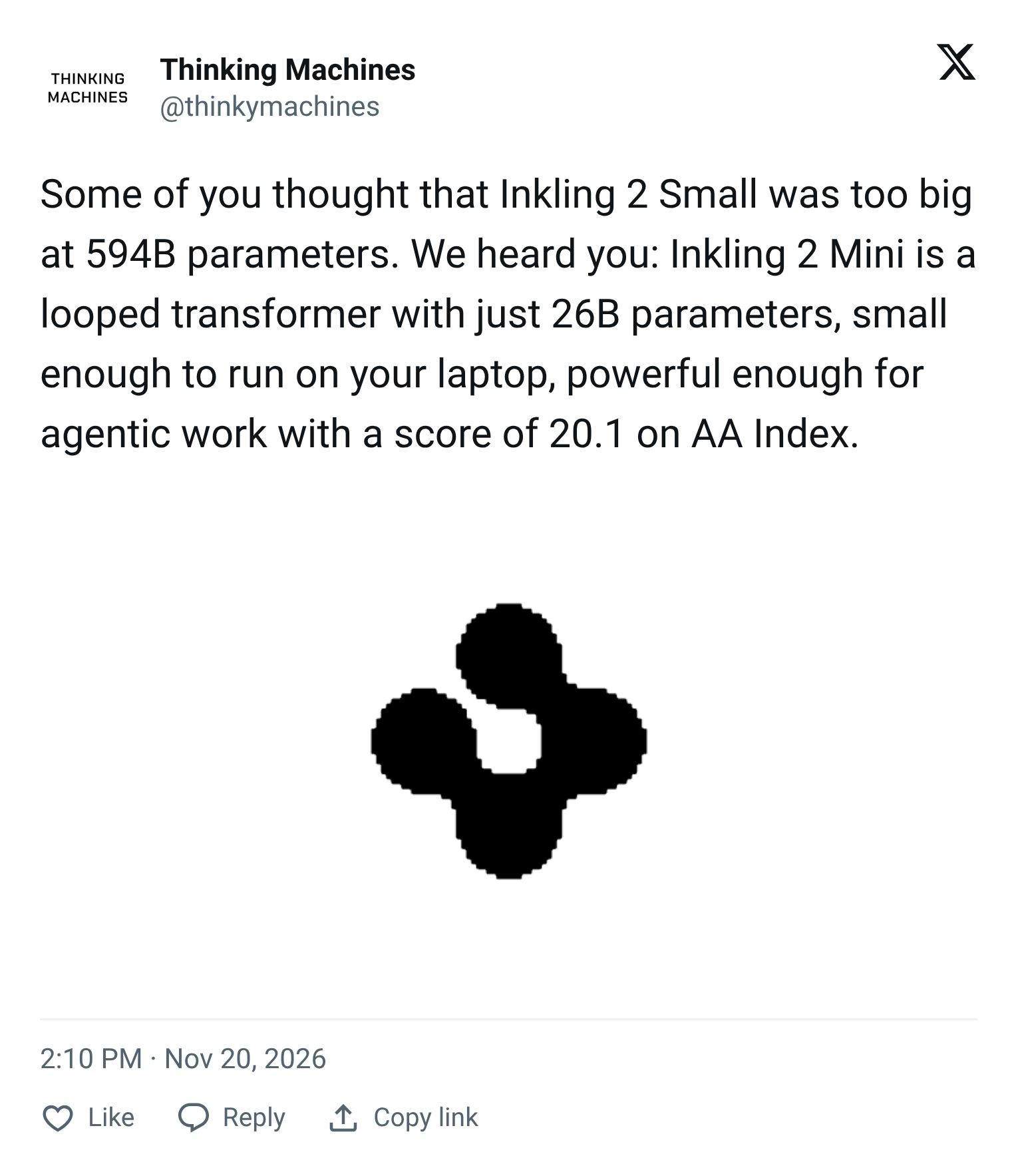
It stores 24 layers and executes 48. The middle 12 layers loop three times per token with the same weights, so a 26.4B-parameter mixture of experts fits in about 20 GB, runs on a 32 GB Mac, and ties Alibaba's dense Qwen3.8-27B at 20.1 on the Artificial Analysis Intelligence Index, while Artificial Analysis measured it about 6x cheaper and 4x faster per task.
The weights you save are real. The compute you save isn't. Each extra pass costs decode time and a second and third KV cache for the looped layers. Looping is a trade of memory for latency, and the tradeoffs show up exactly where local users feel them.
The promise: by the end you'll know how one forward pass visits 24 layers 48 times, how the passes talk to each other through a rank-64 gate, how much each loop costs in milliseconds and KV cache, and why "3.4B active" is now the least informative number on the model card.
The fence: we read Thinking Machines' launch post (including its monitorability study), vLLM's day-0 write-up, the Miles RL recipe, and the tinker-cookbook source at 8bf7dd6 (November 20), plus the Universal Transformers and Attention Residuals papers. The Hugging Face blog, model card and config were blocked from our environment, so the architecture comes from those secondary sources, cross-checked against the cookbook's LoRA tables, which reproduce exactly. The loop code below is our reconstruction from vLLM's description. We didn't run the model.
What It Actually Does
Inkling 2 Mini is a multimodal (text and image in, text out) mixture-of-experts model: each token is routed to a handful of specialist sub-networks, the "experts," instead of all of them.
Released | November 20, 2026, Apache 2.0 weights (with an acceptable use policy) |
Size | 26.4B stored parameters; 3.4B active per pass; 5.4B weight activations per token counting loops |
Layers | 24 stored, 48 visited per token |
Experts | 128 per layer, top-8, sigmoid routing, no shared expert |
Attention | 20 sliding-window layers (1,024 tokens), 4 global; relative-bias, gated |
Context | Up to 1M tokens |
Precision | Trained in 4-bit: NVFP4 experts in layers 0 to 19, MXFP8 in 20 to 23; shipped in the same format |
Footprint | About 20 GB; 32 GB Macs via Ollama, DGX Spark, GGUF from Unsloth |
Price | $0.15 / $0.50 per million tokens first-party; $0.08 / $0.35 on OpenRouter |
Selected results from Thinking Machines' table, against the strongest comparison it shows:
Benchmark | Inkling 2 Mini | Qwen3.8-27B (dense) |
|---|---|---|
AA Intelligence Index v5.0 | 20.1 | 20.1 |
DeepSWE v1.1 | 48.2% | 42.2% |
SWE-bench Verified (bash only) | 79.2% | 77.8% |
Terminal Bench v2.1 | 71.6% | 73.0% |
LongBench v2 | 66.9% | 52.3% |
GDPVal-AA v2.1 | 1319 | 1427 |
AA-Omniscience non-hallucination | 63.4% | 71.4% |
MultiChallenge | 50.0% | ahead |
The pattern: wins on agentic coding and long documents, trails on factual recall and multi-turn chat. Thinking Machines says plainly that looping doesn't add knowledge: knowledge benchmarks didn't move with more passes.
The Architecture, Unpacked

What to notice: the loop never stacks passes on top of each other. Every pass restarts from the prelude output and sees the previous pass only through gated messages, which is why each pass needs its own KV cache.
Four decisions define the design.
Loop the middle, not the end. Thinking Machines tested both. Looping the middle 12 layers beat looping the last 12 on 27 of 28 evaluations, with compute-equivalent gains of 1.51x to 1.91x versus 1.24x to 1.36x.
Passes talk through messages, not residuals. This is the descendant of Universal Transformers (2018), which applied one block repeatedly. Inkling 2 Mini gives each later pass a "message": an attention-residual read over the previous pass's two output blocks, merged into the query, key, value and MLP inputs of every core layer.
Depth mixing with Attention Residuals. Instead of adding every layer's output into one running sum, each layer takes a learned softmax mix over earlier blocks of six layers, from the Kimi team's Attention Residuals paper. One core pass produces two blocks, which is exactly what the next pass reads.
Prune, then heal. The model started with 384 experts per layer and 8 active. In midtraining, two-thirds were pruned to the 128 most used, then the model was healed on 1T tokens distilled from a larger internal Inkling. RL ran for 2,000 steps over 2.2T tokens.
The Code, Annotated
Snippet one: the loop and its gate. Our reconstruction in PyTorch, from vLLM's published merge formula out = (1 − tanh(W_forget·h))·input + tanh(W_gain·h)·message. We ran it at toy scale. Zero initialization is our reading of the launch post's "a learned gate initially blocks the message."
import torch, torch.nn as nn, torch.nn.functional as F

class MessageController(nn.Module):
    """Merges the previous pass's message into one sublayer input (Q, K, V or MLP)."""
    def __init__(self, d=2304, rank=64):
        super().__init__()
        self.down = nn.Linear(2 * d, rank, bias=False)    # rank-64 controller: cheap per channel gating
        self.forget = nn.Linear(rank, d, bias=False)
        self.gain = nn.Linear(rank, d, bias=False)
        nn.init.zeros_(self.forget.weight)                # SnackOnAI: zero init means tanh(0)=0, so
        nn.init.zeros_(self.gain.weight)                  #   out == input: each pass starts as a plain model

    def forward(self, x, msg):
        h = self.down(torch.cat([F.rms_norm(x, x.shape[-1:]), F.rms_norm(msg, msg.shape[-1:])], -1))
        return (1 - torch.tanh(self.forget(h))) * x + torch.tanh(self.gain(h)) * msg   # ← THIS is the trick


def looped_forward(x, prelude, core, coda, read_messages, n_passes=3):
    """24 stored layers, 48 layer visits: prelude once, core three times, coda once."""
    h0 = prelude(x)                          # layers 0-5, run once
    prev_blocks, h = None, h0
    for p in range(n_passes):
        h = h0                               # every pass restarts from the prelude output ...
        msgs = read_messages(prev_blocks) if prev_blocks is not None else None
        h, prev_blocks = core(h, msgs)       # ... and sees pass p-1 only through gated messages
    return coda(h)                           # layers 18-23 continue from the last core pass
The gate makes the loop safe to train: at initialization every pass behaves like the non-looped model, and the network learns how much of the previous pass to let through, per channel, at each input.
Snippet two: fine-tuning it on Tinker (real code from tinker-cookbook, our comments marked # SnackOnAI:).
from tinker_cookbook import hyperparam_utils, model_info
from tinker_cookbook.renderers import get_renderer
from tinker_cookbook.tokenizer_utils import get_tokenizer

model = "thinkingmachines/Inkling-2-Mini"
renderer = get_renderer(model_info.get_recommended_renderer_name(model), get_tokenizer(model))

lr = hyperparam_utils.get_lr(model)          # 0.00075 reference × 0.72 multiplier = 0.00054
# SnackOnAI: never reuse Inkling 2 Small's LR (multiplier 0.57); transfer it instead:
# hyperparam_utils.transfer_lr(lr_small, "thinkingmachines/Inkling-2-Small", model)

n = hyperparam_utils.get_lora_param_count(model, lora_rank=32)
# From the cookbook's table: mlp 10,782,720 + attn 611,328 + unembed 203,328 per rank.
# "LoRA trains one adapter per layer, shared by all three passes" ← THIS is the trick:
# a looped layer's adapter is counted once and learns from every pass.

prompt = renderer.build_generation_prompt(messages, effort=0.9)   # effort is mandatory for Inkling
Fine-tuning a looped model costs no more adapter memory than fine-tuning a plain 24-layer one, because the three passes share both the base weights and the LoRA.
Snippet three: our verification arithmetic. The cookbook's LoRA table pins down the expert layout exactly.
d, L, E, I, V = 2304, 24, 128, 1152, 201024     # hidden, layers, experts, expert width, vocab

# Tinker's shared-outer MoE LoRA: the hidden-side factor is shared, the other is per expert
print(L * (3*d + 3*E*I))     # 10,782,720 ✓ exact match to the mlp entry
print(d + V)                 # 203,328    ✓ exact match to the unembed entry

experts = 3*d*I * E * L      # 24.46B: 92.7% of all 26.4B parameters are experts
mem = (20*E*3*d*I)*4.5/8 + (4*E*3*d*I)*8.25/8 + (26.4e9 - experts)*2
print(mem / 1e9)             # ≈ 19.5 GB: NVFP4 + MXFP8 experts, BF16 for the rest → "about 20 GB"

# Global attention at layers 5, 11, 17, 23 (5:1 pattern); 11 and 17 sit inside the loop
kv = 2 * 8 * 128 * 2                              # bytes per token per layer, BF16 assumed
print(4 * kv, (2 + 2*3) * kv)                     # 16 KiB vs 32 KiB per token: 3 passes double it
print(352 / 175)                                  # vLLM's GB200 KV capacity, 1 vs 3 passes: 2.01 ✓
Three independent checks agree: 24 layers of 128 experts at width 1,152, a ~20 GB footprint, and a KV cache that doubles when two global layers run three times.
It In Action
Task: a local agentic coding session on a Mac, about 30 turns, 128K tokens of context by the end, 15,000 output tokens.
Step one, serve it. vLLM's day-0 command, with the bundled DSpark draft model predicting 7 tokens ahead:
docker run --gpus all --ipc=host -p 8000:8000 \
  -v ~/.cache/huggingface:/root/.cache/huggingface \
  vllm/vllm-openai:inkling-2-mini thinkingmachines/Inkling-2-Mini \
  --reasoning-parser inkling --tool-call-parser inkling --enable-auto-tool-choice \
  --speculative-config '{"method":"dspark","num_speculative_tokens":7,"draft_sample_method":"probabilistic"}'
DSpark reads hidden states at fixed layer visits, so it only works at the default three passes; the variable-loop research checkpoint can't use it. (On a Mac, the equivalent is one Ollama command.)
Step two, memory. Weights take ~19.5 GB. At 128K tokens, the global layers' KV cache is 4.0 GiB (BF16 assumed), plus a fixed ~160 MiB of sliding-window cache. On a 32 GB Mac with 6 to 8 GB left after the OS, that's room for roughly 200K to 260K tokens, not 1M. A million tokens needs ~32 GiB of KV on top of the weights.
Step three, speed. At batch 1, vLLM measured each decode step on a GB200:
Passes | Step, batch 1 | Step, batch 32 | KV capacity |
|---|---|---|---|
1 | 1.51 ms | 3.81 ms | 352K tokens |
2 | 2.67 ms | 5.92 ms | 233K tokens |
3 | 3.85 ms | 8.11 ms | 175K tokens |
Locally, Exo Labs reported 125 tokens/s on a 48 GB M5 Max and 210 on a 96 GB M5 Ultra. At 125 tokens/s, our 15K output tokens take about 2 minutes of decoding.
Step four, against the dense rival. Artificial Analysis measured 9.0 minutes and $0.59 per task for Inkling 2 Mini against 38.2 minutes and $3.53 for Qwen3.8-27B: same index score, 4.2x faster, 6.0x cheaper.
GB200 decode step, batch 1 (ms)
 1 pass   ███████████████▏                       1.51
 2 passes ██████████████████████████▋            2.67
 3 passes ██████████████████████████████████████▌ 3.85   ← 2.55x the 1-pass step
Two extra passes cost 2.55x the step time at batch 1, more than the 2x in layer visits. Looping saves memory, not latency.
Why This Design Works (and what it trades away)
It works because inference compute is cheaper than parameters for local users. Thinking Machines' own ablation: an unpruned non-looped model cost 7.5% less to train but needed 140% more inference compute to match the looped model's loss on 512K-token agentic traces.
It works because MoE and looping multiply. Only 8 of 128 experts fire per layer, so even 48 layer visits touch 5.4B weights per token, close to what Exo's local speeds imply.
It works because the gate makes looping trainable. Starting every pass as a plain model avoids the instability that historically made weight-tied depth hard to scale.
It trades away latency. Batch-1 step time rises 2.55x from one pass to three.
It trades away KV capacity. Two global layers inside the loop need three caches each, halving capacity at a fixed memory budget (352K to 175K tokens on one GB200).
It trades away knowledge. Loops add thinking, not facts: AA-Omniscience is −8.6, with 63.4% non-hallucination against Qwen's 71.4%.
It trades away flexibility. The released model is fixed at three passes. The variable-loop checkpoint exists for research, but loses DSpark.
Technical Moats
The scaling ladder and loop ablations. Knowing that middle layers beat last layers 27 to 1, and that the looped model beats a non-looped one on inference cost, took a predictive scaling ladder few labs can afford.
Native 4-bit training. The weights you download are the weights that were trained, NVFP4 through RL, so there's no quantization loss or calibration step.
A larger teacher. 1T tokens of healing distilled from a bigger internal Inkling after pruning.
Serving support on day one. Per-pass KV caches, fused message kernels and FP32 merges landed in vLLM, SGLang and Miles at launch, so the architecture is deployable rather than exotic.
Insights
One: "fits in 20 GB" describes the weights, not the workload. The headline is true for the checkpoint. But looping doubles the global KV cache, so a 32 GB Mac realistically holds a couple of hundred thousand tokens of context, not the advertised 1M. Long-context local agents will hit the memory wall the loops created.
Two: "active parameters" has stopped meaning anything. For the same model you'll find 3.4B (the launch post, per pass), 3.5B (vLLM), "26B-A5B" (the cookbook's own model_info), and 5.4B weight activations (the launch post, counting loops). The latency table says the honest metric is layer visits: two extra passes cost 2.55x the step time. Compare looped models by weight activations and measured latency, not active parameters.
Surprising Takeaway
Looping roughly halved how much the model wrote down while it reasoned: on GPQA problems it solved at every depth, mean reasoning dropped from 3,703 tokens at one pass to 1,731 at three. Meanwhile its no-chain-of-thought time horizon rose from 16 to 37 seconds of human-equivalent work. That's the efficiency win and the safety question in one result. Thinking Machines found no meaningful loss of monitorability at this scale, legibility metrics held, and the stealth rate in its sabotage test showed no clear trend with loop count. But RL ran only at three passes, and the authors say larger models may behave differently.
TL;DR For Engineers
Inkling 2 Mini stores 24 layers and visits 48: the middle 12 run three times with shared weights, connected by rank-64 gated messages.
26.4B total, 128 experts top-8 per layer; experts are 92.7% of the parameters; ~20 GB as trained in NVFP4/MXFP8.
Ties Qwen3.8-27B at 20.1 on the AA Index, wins on agentic coding and long context, and is 4x faster and 6x cheaper per task.
Loops cost 2.55x decode step time at batch 1 and double the global KV cache; plan local context around ~200K, not 1M.
On Tinker, LoRA adapters are shared across passes; start at LR 0.00054 and always set thinking effort.
Explain It Like I'm New
AI models usually get smarter by getting bigger, which means more memory, more expensive hardware, and no chance of running the good ones on a laptop.
Inkling 2 Mini tries a different trick. Think of a model as a stack of processing stages that every word passes through on its way to an answer. Instead of adding more stages, Inkling 2 Mini sends each word through the middle of the stack three times. It's like re-reading a hard paragraph: you don't need a bigger brain to understand it better, you need another pass.
Because the same stages are reused, the model stays small enough to fit on a well-equipped laptop. Each pass also leaves notes for the next one, so the later passes build on the earlier ones rather than starting over blind.
The catch is time and short-term memory. Three passes take longer than one, and the model has to keep separate notes for each pass about everything it has read so far, which fills up memory faster in long conversations.
There's also a safety angle. Models that think inside these loops write out less of their reasoning, which makes them harder to supervise. The company tested this and found no real problem yet at this size.
If the trick scales, capable AI could run privately on ordinary computers, with the open question of how we check what it's thinking.
See It In Action
Introducing Inkling 2 Mini, Thinking Machines Lab. Read the launch post. Includes the offline flight-simulator demo built on a MacBook Pro in airplane mode, the loop-placement ablations and the full monitorability study.
Inkling 2 Mini on vLLM: Day-0 Support for a Looped Model, vLLM team. Read the engineering write-up. The best technical explanation of per-pass KV caches, the message merge, and the measured cost of each loop.
Inkling-2-Mini serving recipes, vLLM. See the commands. Copy-paste serve configs for GB200, B300, H100, H200 and DGX Spark, with about 4,400 output tokens/s per GB200 at 100 tokens/s per user.
Community Conversation
Thinking Machines (@thinkymachines), launch thread. Frames the safety question directly: "Looping lets a model reason more while writing less, which has raised concerns about monitorability. We studied this as part of our release."
Unsloth (@UnslothAI), GGUF release. Pitches it as "the strongest 26.4B model that runs on 16GB RAM" with 48.2% on DeepSWE v1.1, using quantized GGUFs below the native ~20 GB.
VentureBeat, launch coverage with community reactions. Collects local benchmarks (Exo Labs at 125 to 210 tokens/s on M5 Macs, 104 tokens/s on an RTX 5090) and a minority view of occasional debugging loops and weaker non-English phrasing.
Developer on DEV Community, local-agent field notes. Argues the loop passes can make it slower than a 4B dense model on bandwidth-bound hardware, too slow for live conversational overlays. The author is promoting their own product.
The Right Trade for Laptops, Priced in Milliseconds and Context
Inkling 2 Mini is the strongest case yet that looped transformers belong in production. Running 12 middle layers three times, with gated messages and attention residuals tying the passes together, buys a 26.4B model that matches a dense 27B on the AA Index, beats it on agentic coding, and costs a sixth as much per task. Native 4-bit training means the 20 GB download is exactly what was trained. The trade is honest but real: loops cost 2.55x decode step time at batch 1, and they double the global KV cache, so the 1M-token context is out of reach on the laptops the model was designed for. Use it for local and low-cost agentic coding, budget context around a couple of hundred thousand tokens, and judge the next looped model by weight activations and measured latency, not by active parameters.
References
Universal Transformers, Dehghani et al. The original case for applying one transformer block repeatedly instead of stacking unique layers.
Attention Residuals, Kimi Team. Replaces fixed residual sums with learned softmax attention over earlier layers, the block variant Inkling 2 Mini uses.
Scaling Latent Reasoning via Looped Language Models, Zhu et al. The Ouro LoopLM family, showing looped models pretrained at 7.7T tokens rival models several times larger.
Pretraining Large Language Models with NVFP4, NVIDIA. The 4-bit training format behind Inkling 2 Mini's NVFP4 experts.
Inkling 2 Mini stores 24 layers and runs its middle 12 three times per token, giving a 26.4B-parameter, ~20 GB model that ties Qwen3.8-27B on the AA Index at about a sixth of the cost per task. The loops save weights, not compute: they cost 2.55x decode step time and double the global KV cache, so local context realistically tops out far below 1M.
Sponsored Ad If you enjoy practical AI insights, check out SnackOnAI and support the newsletter by subscribing, sharing, and exploring our sponsored ad—it helps us keep building and delivering value 🚀
State of Product reveals what AI still hasn’t solved

80% of product professionals say AI helps them ship faster, but customers aren’t seeing value any sooner. Atlassian’s State of Product 2027 explores the gains AI is delivering and the challenges that remain, from decision-making that hasn’t kept pace to gut instinct overriding customer evidence.